
Office Clearance Swiss Cottage — Health & Safety Policy
This policy outlines the approach of our office clearance and rubbish removal services to manage risk, protect staff, clients and contractors, and to ensure safe, efficient clearance operations. Scope covers all stages of an office clearance project: planning, waste segregation, transport and final disposal or recycling. The purpose is to establish clear responsibilities and practical controls that align with common safety standards for commercial clearance work.Responsibilities and Leadership
Management will ensure that adequate resources are available for safe working, including training, equipment and supervision. Team leaders and site supervisors are responsible for implementing the policy on-site, completing risk assessments, and ensuring that all operatives hold the necessary competency for removal, lifting and hazardous handling tasks. Employees and contractors must follow procedures, report hazards and wear issued personal protective equipment (PPE).
Risk Assessment, Permits and Site Protocols
Before work begins a documented risk assessment will be completed for each office clearance, considering structural constraints, manual handling risks, sharp items, electrical hazards and asbestos risk indicators. Control measures include safe access routes, exclusion zones, and the use of mechanical aids. Standard site protocols include:- Pre-clearance walk-through to identify hazards
- Segregation of recyclable materials and hazardous waste
- Clear marking of storage and loading areas
- Use of approved lifting techniques and equipment
The company places a strong emphasis on manual handling controls. Training in correct lifting, use of trolleys and hoists, and team-lift techniques is mandatory. When handling bulky office furniture or heavy equipment, operatives must assess the load and use mechanical assistance where appropriate. Any item that presents a doubt must be assessed and can be refused until a safe method statement is in place.
 Personal Protective Equipment (PPE) requirements are set according to task risk: gloves, high-visibility clothing, safety boots, eye protection and face masks where dust or biohazard is likely. PPE is maintained by the company and must be used consistently. A check-in/check-out system records PPE issuance and condition, and damaged equipment is removed from service immediately.
Traffic and vehicle management form a key part of site safety for our rubbish removal operations. Loading and unloading must be performed in designated areas, with banksmen directing vehicle movements when visibility is limited. Vehicle checks and secure load procedures ensure safe transport to transfer or recycling facilities. Drivers must comply with load limits and secure loose items to prevent road hazards.
Waste Classification and Environmental Controls
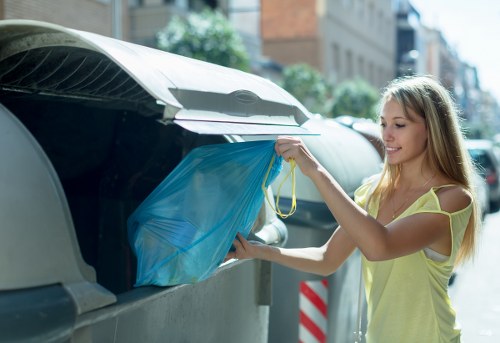
Waste will be classified to ensure correct handling and disposal: general office waste, recyclable materials, electronic waste and potentially hazardous items such as batteries or chemicals. The policy requires minimising landfill through reuse and recycling routes and ensures compliance with environmental obligations. Records of waste transfer and chain-of-custody documentation are maintained for accountability.Emergency procedures are documented and communicated. This includes spill response, first aid arrangements and evacuation plans. Trained first-aiders are assigned to clearance sites, and emergency contact procedures are posted where appropriate. In addition, an incident reporting system captures near-misses and accidents so that lessons can be learned and corrective actions implemented.
Training, Monitoring and Continuous Improvement
Regular training programmes cover safe working practices, manual handling, hazardous waste recognition and on-site supervision skills. Routine safety audits and toolbox talks ensure compliance with this health and safety policy. Performance metrics, including incident rates and audit findings, are reviewed by senior management and used to update procedures. Continuous improvement is driven by feedback from operatives and audit outcomes, ensuring that office clearance services evolve to maintain high safety and environmental standards.All operatives are required to participate in induction and ongoing refresher training. Competence is assessed through observation, practical assessments and workplace supervision. Any subcontractors engaged to carry out clearance tasks must demonstrate alignment with these safety expectations and provide evidence of their own risk management systems.
Documentation and record keeping are fundamental. Risk assessments, method statements, training records, equipment maintenance logs and waste transfer notes are retained as part of the company’s compliance and quality assurance processes. These records support transparency and enable effective management reviews.
Review and Policy Update: This health and safety policy for office clearance operations is reviewed periodically and after any significant incident or change in operational practice. Revisions ensure that clearance work, rubbish collection and related service activity remain safe, efficient and environmentally responsible. The company is committed to applying practical, proportionate controls that protect people and property while delivering professional office removal and clearance services.
